
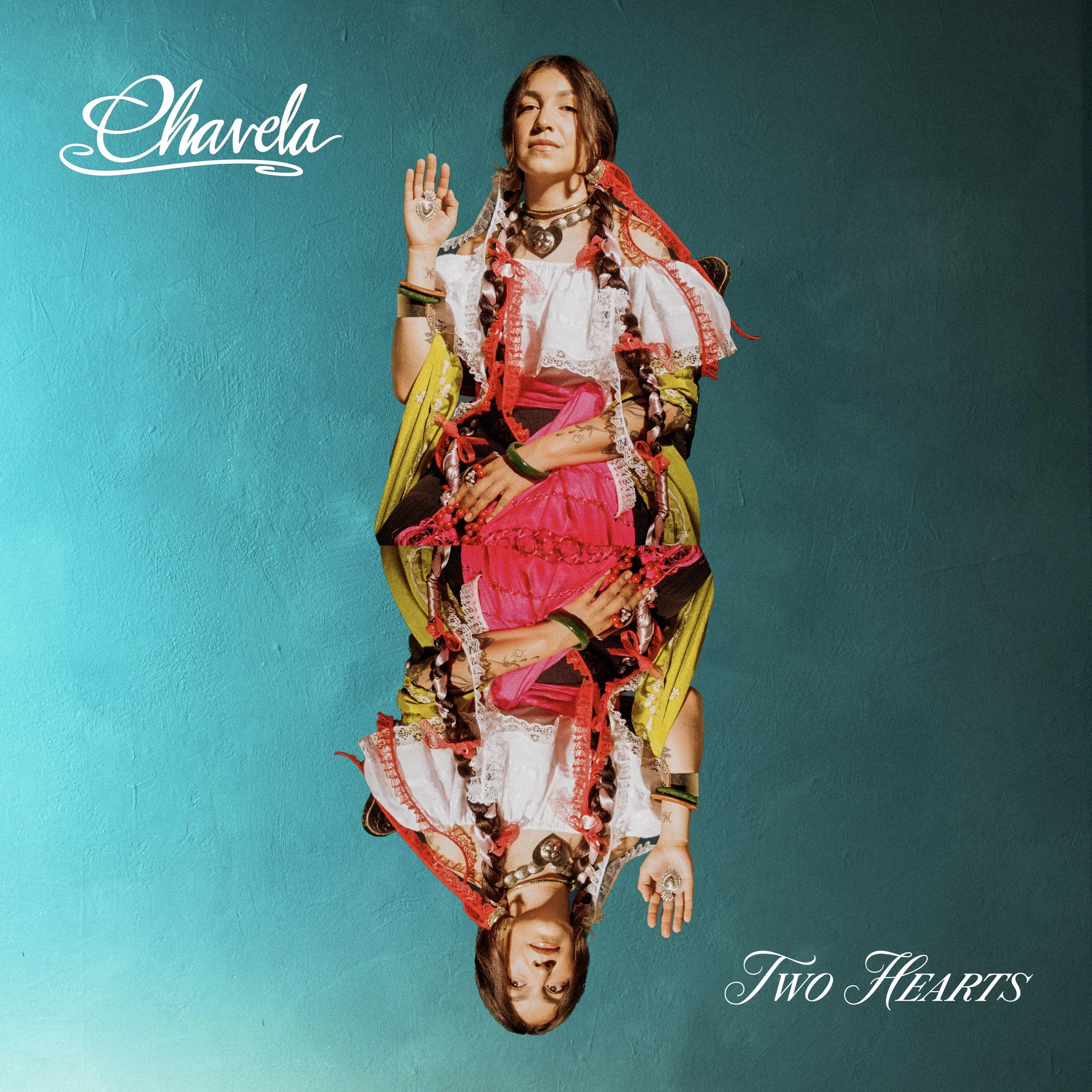
Chavela’s “Two Hearts” cover art draws inspiration from the Two of Hearts playing card, blending Victorian imagery with the vibrant colors and textures of traditional Mexican textiles. Photographed on film by creative director Alysse Gafkjen, the artwork reflects the song’s central theme: two hearts and two sides to every love story.
I’m trying to remember the last time I emerged from heartbreak with even the slightest tingle of hope. I’m sure at some point I’ve longed for a breakup to feel like that clip of Drew Barrymore smiling and laughing in the rain, overcome by the realization that life is beautiful.
I think Chavela’s music does that to me, though.
On her latest two-song release, singer-songwriter Isabella Paillao, who performs as Chavela, trades some of her usual jazzy, soulful sensibilities for a little country grit. Her voice remains rich, dense, and smoky, but her music takes on a newfound lightheartedness, even when the subject matter is anything but.
On “Two Hearts,” the first of the two tracks, Chavela offers a more playful take on heartbreak. Bright guitars, a bouncing drumbeat, and a buoyant melody give the song a sweetness that almost disguises the sadness of its lyrics.
It’s a song about a relationship that has run its course, but rather than wallowing in its demise, Chavela gives us something we can hum and tap our feet to.
Paillao cites Norah Jones’ 2009 album The Fall as a particular influence, drawing inspiration from its “sparkly,” guitar-driven arrangements and classic pop-rock tendencies.
The song eventually found its footing when she began working with producer Dante Schwebel-Vela, who helped bring the arrangement to life alongside a band of musicians whose influences ranged from the Ronettes to Bill Withers.
“Johnny Radelat’s drumming almost mimics the intro of The Ronette’s ‘Be My Baby’, Dante’s acoustic rhythm leaned very Bill Withers, and the vastness of the recording room gave us this ‘Wall of Sound’ character that we didn’t know we were going to get before recording,” she said.
One of the song’s most affecting lines is “I’ve grown so cold since I can’t curl up into your mold,” which works as a double entendre. On one hand, it evokes the physical familiarity of sharing a bed with someone for so long that their absence becomes something you can feel in the indentations they left on your mattress. On the other, it suggests the ways we contort ourselves to fit into another person’s life, sometimes making ourselves smaller in the process.
It’s an admission that there is sometimes comfort in confinement, in knowing where you belong, even when the space you occupy no longer accommodates the person you are becoming. Eventually, you find yourself having to surrender the familiarity of a life that once fit so snugly.
“Lyrically, the song started as sort of a journal entry,” she explains. “I wasn’t ready to fully unpack the relationship that I was referencing, sort of like avoiding therapy, so I put it to bed.”
She would eventually return to the song more than two years after she first began writing it, with a little more distance between herself and the feelings that inspired it.
What I appreciate about the song is that Chavela doesn’t seem interested in making anyone the villain. All the sharper feelings that accompany heartbreak—the spite, resentment, rage, and jealousy—seem to have been sanded down by time, leaving behind something softer and more wistful. Instead, there’s an understanding that two people can experience the same relationship very differently, and that sometimes love, however genuine, isn’t enough to make two people right for each other.
If “Two Hearts” finds Chavela making peace with the end of a relationship, its accompanying B-side, “At the Top,” entertains the possibility of picking up where things left off.
The song takes on a brighter, more hopeful sound, with jangling guitars, cheerful tambourine, warm piano, and layers of percussion that give it an almost gospel-like exuberance.
It’s also almost impossibly wholesome and optimistic, with a sunny disposition that wouldn’t feel out of place in a television commercial promising brighter days ahead. I don’t mean that as a criticism, but rather as an observation of how dramatically its cheerfulness departs from the more intimate, melancholy qualities of Chavela’s previous releases.
That levity owes something to the recording process, which saw Chavela and her collaborators experiment with a variety of acoustic instruments at Fringe Complex on San Antonio’s West Side.
The recordings brought together a sizable ensemble, with Paillao contributing vocals, nylon guitar, and xylophone; producer Dante Schwebel-Vela on electric and acoustic guitars; Johnny Radelat on drums and percussion; John Michael Branch on bass; David Jimenez on acoustic guitar; Carlos Meza on upright piano and auxiliary percussion; Anthony Farrell on organ and Rhodes; and Brianna Smith on background vocals.
“Using as many acoustic instruments as we could from xylophone, tambourine, congas, upright piano, layers of steel string guitars and my nylon guitar, we left the studio with this dreamy, Motown-sounding, multi-layered story of a song,” she recalls.
Lyrically, however, the song is a bit more complicated. Chavela revisits the possibility of rekindling an old romance, wondering whether two people can simply resume loving each other.
“Are we gonna pick back up where we left off?” she asks, before suggesting, “Maybe we could keep on loving like we’ve never stopped.”
It’s a sweet sentiment, although perhaps a little naive, as anyone who has ever entertained the return of an old flame might recognize.
The song itself almost didn’t make it past that initial idea.
“‘At The Top’ is another one I sat on for almost a year,” Chavela explains. “Inspired by true events, the song is about an old flame coming back around. The hook came to me on a quiet drive home, but I felt stumped on where to take the song.”
It wasn’t until she brought the unfinished idea into the studio that the arrangement began to take shape, with bassist John Michael Branch and Schwebel-Vela helping her work through the composition.
And while “Two Hearts” and “At the Top” occupy different emotional spaces, they share the same underlying refusal to become cynical about love, even in the face of disappointment.
There’s a persistent willingness to remain vulnerable and entertain the possibility of loving and getting hurt all over again.
Taken together, the two songs are two sides of the same coin: one finds peace in letting go, while the other wonders whether something lost might still be worth holding onto. It’s that endlessly contradictory human experience of knowing better and still rooting for love in spite of it all.
“Two Hearts” and “At the Top” were released on Friday, November 13, and are available to stream on Spotify, Apple Music, and other major streaming platforms. Chavela will celebrate the release with a single release party at Lighthouse Lounge on Saturday, November 21, at 9 p.m., alongside Mockingbird Express.